
With the hybrid model in place, employees can take advantage of the working from office to build better working relationships, trust, and comradeship.

Expert staff in the line of fire in the tech sector. Analysts attribute these job losses to a slowdown in growth, automation of lower-end work.

Upskill. Network. Increase your employability status. Don't be redundant, says Gaurav Vohra.

Market regulator is trying to build a large team of software experts for efficient monitoring and surveillance

This week's digest of weird, true and funny news from around the world

With the demand for lower costs in process driven activities and a move away from the high rate, billable hours of legal services, AI platforms are being used internationally in many legal tasks.

'You will see more and more people working independently -- starting beauty parlours, driving cars, etc.' This is what we call the gig economy.' 'The same people who have been laid off in India or are unable to get visas to work in the US may be part of this gig economy.' 'India needs billions of jobs, and it can only be created by self-employment or the gig economy.'
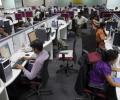
NITI Aayog recommendations cite the need for greater industry-academia collaboration to meet skill demand

Wipro has been quite aggressive among Indian IT services companies in acquisitions as a strategy to buy the capabilities in emerging technologies.

Several factors have held India back. One is DoT policy somersaults and lack of clarity on whether to or not to ban Chinese gear makers.

The countries with positive employment outlook included India, Mexico and Turkey, as also the Gulf Cooperation Council region.

Indian firms, which experts say stand to gain from the European Union's upcoming General Data Protection Regulation (GDPR), are struggling to understand the policies.

Over 5 million alumni from the Indian Institutes of Technology, Mumbai University and Institute of Chemical Technology, Mumbai, plan to raise Rs 21,000 crore to start the world's largest infection testing lab in Mumbai.

'Everybody says 5G and communication is important.' 'Everybody says automation, robotics, human computing interfaces -- people and machines working together -- is the future.' 'Everybody agrees that cybersecurity is something that is here to stay.' 'Everybody agrees that synthetic biology is important.' 'Instead of outlining thinking about industries for tomorrow and the future, let the evolutionary pathway be built in a way that it promotes robust, creative, thinking.'

'If we chose to do the right things, it is possible to avoid job losses at a mass scale,' ABB MD Sanjeev Sharma tells Raghu Krishnan.

The Big Two telecom companies have accelerated their moves towards this next-gen technology, though they have chosen very different routes to getting there.

British Prime Minister Theresa May will be in India tomorrow, but Cyrus Mistry will no longer head the Indo-UK CEO forum.

'The rupee has lost value against all other major Asian currencies, including that of Bangladesh and, of course, China.' 'Why should this be the case when the Indian economy has been growing faster than these economies, other than China?'

Writes to Trai, Mumbai Police to catch unauthorised SMS senders

Company expects to be back to industry leading growth in FY17.

AI, cloud computing, data analytics are a few areas companies are looking for proficiency in

'LinkedIn is supposed to be this super-connected social media network for professionals that I reluctantly joined at the persistence of a former colleague appalled at my lack of self-promotion.' 'Well, I'm out there and I don't know who knows me, but I do know that LinkedIn's algorithm definitely doesn't,' says Kanika Datta.

The unemployment situation is becoming increasingly acute.

Here's your weekly digest of the craziest stories from around the world.

It's time you up your skills set to stay relevant in the industry.

India's IT/BPO story isn't over yet, believes Ganesh Natarajan.
India's IT/BPO story isn't over yet, believes Ganesh Natarajan.

Branch additions for most major banks in the current financial year do not correspond to the number of the past two years.

It won't take away your jobs. It won't destroy you.

At the GO-JEK hackathon in Bengaluru, there were over 100 people working on their projects. Most were between the ages of 25 and 30. All except the CoderDragons: Mrinal Jain is 11, and Shreyas Katuri is 12. Nikita Puri meets the pre-teens who are building a virtual voice assistant named Erica.

Indian companies seem to be trailing behind. They will have to catch up by reskilling the workforce and ramping up investments.
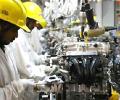
The company adopted the scheme from parent Suzuki, where employees are rewarded for making suggestions to improve productivity and cut wastage.

'It is important that employees are trained to acquire skills that would be needed in future, when the company sees disruption coming -- that is, much before the disruption occurs or the company plans to change the business model,' says Asish K Bhattacharyya.

Wipro has a good brand because of the trust and quality it enjoys globally.

The PM will pay a two-day visit to Japan from October 28-29 to hold the annual India-Japan summit with Abe. The focus of the visit will be to further expand cooperation in the Indo-Pacific region, carry out joint infrastructure projects in third countries and further boost ties key sectors like defence and trade.

In an online chat, career counsellor Amit Bansal shared crucial career advice with readers on how to pick the right stream and college to study engineering.

'In the next 14 years, 100% of US energy will be clean and solar.'
'Jobs will exist at very high levels or low levels of skill sets.' 'People, who are in middle level jobs, are the ones who are facing the problem as such jobs are fast disappearing because of technological advancement.'

A culture of science and innovation must be embedded in society wherein people not only use new technology but understand it as well. Without this, obscurantism and blind faith can sit side by side with digital technology and, in fact, use the same technology to reinforce their hold on people, says Shram Saran.

In his first Republic Day-eve address to the nation, the President also said that institutions should be "disciplined and morally upright", adding they are always "more important" than the individuals in office. The institutions should also respect their "fraternal relationship" with other institutions, he added.
